Project Description
‘The Recorder’
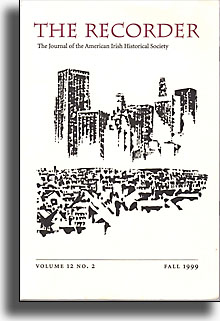
From THE RECORDER, The Journal of the American Irish Historical Society,
Diary
My Book of Days
I am conscious of not having done enough, beyond keeping going, of not saying what I should have said. There is no record of what I thought or felt at this or that time, at all those times when silence should have been broken. But then, I come from a community of people famous for their reticence, know for their dourness, and who feel themselves more talked about than listened to, anyway. We have tended to rest our case on a certainty that there is a real thing named truth and that truth will out in the end, not knowing any better: not knowing that it is not the word that is the thing, but how the word is used.
So much depended ona black bin linerthe humped plastic glazedwith pure rain wateras is the black tarmacadam the blackthorn hedge
A diary, to be proper, has to be more than just an accurate record of how or where consciousness and the world meet – it is the record of the meeting, itself. It does not mirror the meeting – it is the meeting, without censor, without mediator; in other words, it is what poetry is.
The pages of my diaries are uncut, our ghosts imprisoned, within; my book of days is a flux of matter, fenced in by the rule of calendars, corralling a scattering of this and that, bridling the chaos of small things, marks, signs, sounds, signals half apprehended in passing and indifferent, in themselves, as to whether meaning is taken, or not taken.
The clock in the kitchen was big and round It was cream coloured and electric Its second-hand quivered with each Grunting heave.*The floor had tiles of speckled terrazzo Brown flecked, like a wild bird’s egg. There was gravel on the yard That had to be weeded, by hand, And beyond that A flower garden And a field, on the other side of that; The well was there With a mechanical ram that shunted, day and night, Shouldering water to the house and yard.*Such invocations were everywhere: The ticking of the clock High on the wall The spat, spat, spat of rain on the window pane The shunt, shunt of the ram Cows lolloping about the gate, At five, Their shadows, like clounds about my head The soughing of their hooves, pulling against The unknowable deep, thick clabber’s black lips. Yet, for all that, such lexicon, such utterance: The ram, the cows, The milking machine, The clock. Such grandiloquence: Rain, rain, rain Showering heavily on gravel.
A diary is a poor thing when it attempts to exercise control over history or, above all, over time; then it becomes one person’s varnish against the corruption of another’s truth.
Politically, a diary is an investment marred by interest. A poem is all disinterest, all engagement.
A man with a good eye (A bat-maker, say, buying a willow tree) Can tell the quality of the inner wood From the condition of the bark.*Where time and discourse meet and marry; When private reflection becomes war reportage The ideal of articulation is achieved: there It is brought into being For no other reason Than that this is how it is.*Oh, all those past-tense exhortations! 0h! Oh! Recognise what were our sufferings.
I was eight years old when my grandfather died. I remember crying, outside, in daylight. He died in the depths of night, in bed, beside my grandmother. Over the years, that became an image of fidelity and a kind of model of a good death – stepping over the threshold quietly, with probity, without fuss, with dignity, silently, like an otter into water. He had a moustache and wore a waistcoat and a shirt with no collar. My eyes were level with the knees of his trousers, or so it seemed.
As by tradition, The mound is garlanded, The ligature of bright petals Bar–coded in declarations Of love, praise, regret.Misery prompts the hope That such publications May be audited (even known of), There, within that dark, Unapproachable place.
At the back o the house was the vegetable garden; at the front, a wee plot devoted to flowers.
Digging, once, I unearthed a rust-eaten revolver under the hedge that bounded the vegetable garden. Finding it fuelled my half-belief that buried treasure really did exist. Given its size (and the wooden butt had rotted away) adventure-book death was unexpectedly heavy, real, solid, in my hand; I cleaned it, I used it to dream myself soldier, sailor, hero, Biggles deep behind enemy lines, living of the land.
I learned to tell time on a dandelion clock; how to make a boat from a single rush taken from the river-bank, how to pin it into shape using only a thorn.
When I was a child And the window-glass Grew grey-white with condensation (We called it mist) I’d be tempted to make my marks Against its purity of expanse. It might be coming on to dusk And there would be rain falling And I would view out into the darkness, Out through those narrow openings, Out past the flat, dribbling raindrops While the running edges of my tottering lines Still held, a bit: for soon, I knew, they would fade, speedily run off Into patterns of grey crazy-paving, Leaving me guilty and dismayed In the presence of my own slagh, my ghostly creation: With a wipe from the heel of my hand I would destroy the evidence, Then sleep.
And, its body, wedged between those wound up legs, is all potential – the epitome (though pregnant, only, till achieved) of purposeful propulsion. In both states, waiting and the opposite of waiting, it achieves a beauty.
And so, there it is, in the now – not waiting, for waiting implies an awareness of the existence of time (and it has no memory of the past, no thought of the future). In both states it is outside time; it just is.
We learned what time was, from inside its making: Learned the illusion of its mastery, How to use a plucked dandelion to count the minutes Or how to finger back across the years The growth rings on log or tree stump Their brown, fibrous edges furred By the raw-toothed kiss of the crosscut saw.*A little yellow frog, on a bed of autumn leaves Appears to be, or for the moment is, dead to the world; Looking at it, not even a pulse is evident Where broad throat meets sloping shoulder. Yet, When some pre-determined conjunction of conditions Is just right, The loaded body Will explode from between braced legs, Into the world of time.*A V of geese passes overhead, And is gone. Darkness falls. Across the fields A dog barks And is quietened. The wind blows; A leaf of grass Bends, then Rises.
I was not allowed to write on the window pane – fingers left oily traces that were difficult to clean. Yet, I could see that adults left trenched dates and initials on cement paths, foundations and steps.
My first pencil was my finger My first page, a window pane Water, my first tactile material, My first sense that the world was made of language The rumble, rumble of potatoes in a basin Meant dinner. The strib, strib, strib Of milk striking the bucket (Everything, in the byre, was narrative and studied punctuation, no prattle) Told a tale; Then, the immediacy of Vertical and horizontal lines Appearing beneath my finger And the black night invited through, Decanting, incanting mystery upon mystery*The beat of drums rolls across the fields Rattling the glass Sending big raindrops wobbling off course; The fear, the hanging ache Of caravans crossing deserts, Of wagon trains traversing plains.
Or, we’d take sticks from the hedge and sharpen them with the ever-ready penknife, and use them to tattoo dissolving devices in the black, coagulating, pools.
Then, if we had string to hand, we’d find three stones of more or less equal weight, tie measured lengths of string to each and knot the free ends together. Then, resting the bolero in one hand, testing the weight, finding the balance, deliberating and taking aim a dozen times, we’d send the spinning object heavenwards, exulting as it snapped around the thin telegraph wires.
We found we could make our marks on the sky Telegraph wires our copybook lines, The symbols of our aimed endeavour Hanging there, rocky notes on string, A symphony Played by the wind, while those Jigging shadows danced among Us, at our roadside levee.*Beneath the dancing wire We’d score the Jolly Roger Knifing it out In time to the coming and going Of passers by, Delighting in bulbous bones The great staring eyes The empty mouth, mute, Gorged deep In the trunk’s grainy flesh. The skull, blank, otherwise.
Not greatly favoured in the ownership of parchment we made our marks habitually on fence or gate-post, or on living trees. The smooth, hard bole of an ash or the tough, rough-faced oak were challenges to our tin-bladed penknives.
On one tree a person, a man, a young man, had hammered home many nails, had set them just so, to form a set of initials and a heart, complete with arrow. The bark of the tree was working to erase his rusting assertion, but doing so with a slow grace and courtesy.
Once I went to visit Wordsworth’s old school And had pointed out to me the spot where, He had cut his initial letters on a school desk.*Time changes vandalism to heritage; An American came after me to stare, To note, this first published work.